When Using a Compass to Explore an Area
Weblog Homepage / Tips & Tricks
How to Use a Compass (And Why You Should Learn!)

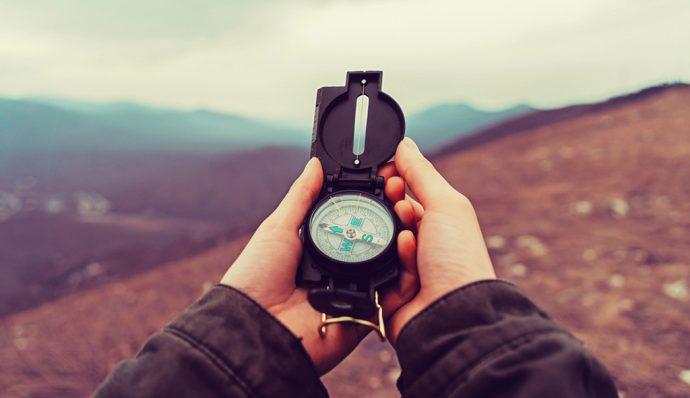 Learning how to utilise a compass tin can seem needless in our age of technology. Afterward all, we have GPS devices that tin can exercise the same piece of work with less effort. Nonetheless, knowing how to use a compass is crucial when you're planning a hike. A hiking GPS could run out of batteries. If you lot happen to drop it, it's pretty easy to break, and a poor indicate tin can render it useless. Without a backup programme, information technology's piece of cake to get lost in the woods and hard to get out. Part of this is concrete. You accept a ascendant leg in the same mode you have a dominant hand — in fact, they're on the same side. This becomes problematic when you're lost in the wood. Your dominant leg by and large has a longer footstep than the other, which often leads to walking in circles. Disorientation is also a problem. When you've been off-trail for a while, yous're jump to get scared and end thinking logically. It becomes much harder to distinguish between new landmarks and ones you've already seen. The longer you lot're lost, the more dislocated yous get, and the more likely you are to make poor decisions that tin can atomic number 82 to disaster. But by learning to use a compass, you guard against these dangers. You have reliable, effective tools at hand to make sure you lot tin can always discover your way. Table of Contents
- The anatomy of a compass
- Necessary vocabulary
- How to use a compass
- How to employ a compass with a map
- Dealing with obstacles
The anatomy of a compass
In gild to know how to use a compass, first you need to empathize is each of its parts:
- The base plate is the flat surface upon which the rest of the compass is mounted. It's hard and rectangular and so that information technology can stay level, which helps yous get an accurate reading, and to assist in drawing direct lines on a map. At that place are rulers along its edges, and some base of operations plates have scales. Both help you measure altitude.
- The compass housing is a circular plastic bubble that holds both liquid — ordinarily booze — and the compass needle. The liquid allows the needle to rotate freely.
- The compass needle is a magnetized piece of metal. One end is unremarkably painted reddish to mark "Northward." Information technology sits on a fine point that'south nearly frictionless, helping the needle to rotate easily through the liquid.
- The bezel is a rotating ring that surrounds the compass capsule. Information technology'southward marked with degrees (0 through 359), compass points (North, North-East, Eastward, Due south-East, South, S-West, West, and North-West), or both.
- The orienting arrow sits within the compass housing and rotates when the bezel is turned. When you lot take a compass bearing, you marshal it with the compass needle. It tin can likewise exist used to make sure the compass needle is always pointing due north, giving you the correct direction of travel.
- The direction-of-travel pointer is marked on the base of operations plate and should always point toward your intended destination. It tin can also be used equally an index line when taking your bearing reading.
- The index line is sometimes an extension of the direction-of-travel arrow. Other times it's a black line inside the bezel or an arrow on the base of operations plate. It's used to take your compass bearing.
- Orienting lines sit down inside the compass housing. They align with the horizontal lines on a map (easting lines) to make sure you lot align with grid n: the superlative of your map.
Necessary vocabulary
Whether you'll be using a compass with a map or on its own, there are a few terms you'll need to understand first. For instance, there are three 'north'south when information technology comes to compasses and maps. 'True north' relates to where the physical due north pole is and it's actually not relevant when information technology comes to navigation. 'Grid n' refers to the peak of your map, simply instead of being a single point, it's a line; it's as if the world is flat and the unabridged top of the map counts as n. The last 'n' is 'magnetic due north,' which is where the compass needle points. It's controlled by the earth's magnetic field. You too should know the nuts of magnetic declination, or just 'declination.' This refers to the number of degrees betwixt true north and magnetic northward and whether they're to the east or west of true north. If magnetic north is eastward of true northward, the declination is positive, and if it's west, the declination is negative. For example, the declination in Boston, MA (where I'chiliad writing) is -fourteen degrees, since information technology'due south 14 degrees west of true north. Declination changes over time considering of normal magnetic activity, so make sure that if you're using a map, it'due south as current as possible to reflect the near contempo declination readings. Speaking of maps, there are some words to learn — or review — if y'all want to use one with a compass:
-
- A compass rose is a symbol, unremarkably a circle with points within it, that shows which way north, south, east, and west are on the map. Information technology may also show n-east, north-westward, southward-east, and due south-west.
- Breadth lines go east-due west, i.e., horizontally across the map, and bespeak how far north or s of the equator you are. On the other hand, longitude lines run north/south, i.due east., vertically on the map, and indicate how far east or west you lot are of the prime meridian, which runs through Greenwich, England. If you take problem telling them autonomously, think of 'latitude' as rungs on a ladder — which run horizontally.
- The map's scale indicates how 'zoomed in' you are on the expanse. It's usually written as "i:X," which means that one unit on the map represents 'X' times that number off the map. The maps made past the U.s.a. Geological Survey (USGS) use a calibration of i:24,000, meaning that one inch on the map equates to 24,000 inches or about 0.38 miles in the outside earth. There could also exist a altitude scale which shows how inches on the map stand for to real-life miles or kilometers.
- The twelvemonth of production is the date on the map that shows when the data on the map was collected. This is important when determining whether the map is upwards to date and if the declination listed is still authentic.
- The year of revision is the engagement the map was updated. Information technology may or may not exist, depending on if the map was revised.
- If there's a 'photograph revised' date on the map, this refers to the concluding time the map was updated based on photographs of the area.
- Contour lines trace geographic features to betoken their peak. The contour interval is crucial to understanding what the profile lines hateful. Similar a distance scale, it shows what the departure in elevation betwixt the contour lines is, so that yous know the superlative of land features effectually you.
- The map'southward legend explains what the symbols and colors on the map mean. Some common colors are black (manmade features), blue (water), brown (profile lines), green (areas of vegetation), white (areas with little-to-no vegetation), red (highways and boundaries of public lands), and regal (features added after the photograph revised date).
How to utilise a compass
At present that you know the vocabulary, information technology's fourth dimension to put your skills to use:
- Commencement, figure out where y'all desire to go. Permit'due south say information technology'south a mountain. Face up that.
- Agree your compass flat in your palm and hold your palm in front end of your breast.
- Adjacent, find out which way you're facing. Look down at the compass needle to run into which fashion the cherry-red bespeak is facing — that'due south magnetic northward.
- Rotate the bezel so the orienting pointer points toward magnetic north. The place where the management-of-travel arrow aligns with the compass point on the bezel shows which way you're pointed. If your bezel has degrees instead of compass points, you'll have to convert them to compass points. For your convenience, n is 0 degrees, northeast is 45, east is xc, southeast is 135, south is 180, southwest is 225, due west is 270, and northwest is 315. More precise directions are in between. This is called getting your bearing.
- At present continue walking in the direction of your bearing. Every so often, repeat steps 1-4 to make certain you're headed in the right direction.
How to employ a compass with a map
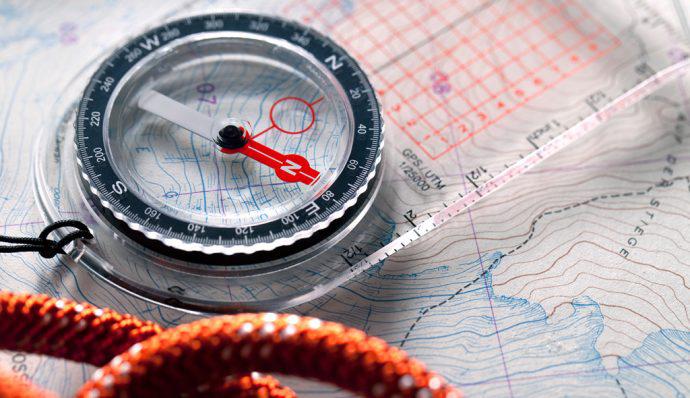 Using a compass with a map is similar to using a compass without a map — except you have an extra tool to assist you!
- Pace 1: First, get what you need: your compass, map, a long piece of cord, and the declination of the expanse. Make certain the map covers the entirety of the area you'll be traveling in, plus some extra for safety's sake.
- Stride 2: Identify your map on a level surface with due north on the compass rose facing upwards. Apply the string and the map's scale/altitude scale to decide how far you'll be hiking. Be sure to spotter for contour lines and intervals, the greater the alter in acme you encounter, the longer the actual hiking altitude, although the distance on the map remains the same.
- Step iii: Put the compass on top of the map. Make sure you lot're far abroad from any metal — this could mess with the magnetization of the compass needle.
- Step four: The first step to taking a begetting is figuring out where you are on the map (point A) and where you desire to become (bespeak B). If y'all know where you lot are on the map, skip alee to step 7. Otherwise, look around and find two easily identifiable landmarks, then observe them on your map using the legend. Choosing unique landmarks is important hither — you don't want to misidentify a landmark and end upward lost. In one case you've found them both on your map, mark them as L1 and L2.
- Pace 5: Hold the compass flat on your palm and hold your palm in forepart of your breast so that the management-of-travel arrow points towards L1, so rotate the bezel until north (or 0 degrees) aligns with the northern end of the compass needle. Accept the heading where the direction-of-travel arrow meets the bezel.
- Step 6: Next, put your compass on the map with the edge touching L1. Turn the base plate until the orienting lines inside the compass housing line up with the easting lines on the map. Then draw a line through L1 using the side of the base plate equally a guide.
- Footstep 7: Repeat steps four and 5 using L2 instead of L1. When you're through, yous should have two intersecting lines on your map. The point where they cross is your location.
- Pace 8: Now apply the side of your base plate to line up point A and point B with the direction-of-travel arrow pointed toward B. If your base plate is also short, employ a string to create the line and place the base plate alongside.
- Step 9: Plow the bezel so that 0 degrees or north point to grid n. The orienting lines should align with the easting lines on the map.
- Stride x: Now it's time to account for declination. Let's use mine: -14 degrees. Add fourteen degrees from your bearing to account for the departure betwixt magnetic north and grid north, i.east., to interpret your work from the map to the real world. Always subtract a positive declination and add a negative one.
- Pace 11: Lift the compass off the map and agree it flat in your palm with your palm in forepart of your breast. The direction of travel pointer should exist facing away from you lot.
- Step xiii: Rotate your whole body until the orienting arrow aligns with the northern tip of the compass needle. Practise non move the bezel.
- Footstep 14: Once the needle and pointer are aligned, find a landmark along this bearing, walk until you go to it, and brand certain the orienting arrow and compass needle are still properly aligned. Brand corrections as necessary, and repeat this step until you reach signal B.
Dealing with obstacles
Sometimes, despite the best-laid plans, you're going to run into obstacles. A downed tree, a swampy area, or a big patch of ice could be a deal-breaker on your form — unless y'all know how to use a compass to go around. No need to panic, though. It's actually a elementary process:
- Stop when you accomplish the obstacle and take your bearing again, with a map or without.
- So add or subtract 90 degrees from your bearing. Notation: It doesn't matter if you add together or decrease. You lot're merely walking in a box-shape around the obstacle. However, if things expect clearer to one side than another, set your bearing for the path that'south easier. For case, if your begetting was 170 degrees, your new bearing would be either 80 or 260 degrees.
- Now hike forth your new bearing until you've cleared your obstacle. Make sure yous keep track of the distance you've traveled. An piece of cake way is to count your paces. Endeavor to continue your steps even then that your count is reliable.
- In one case you lot've cleared the obstruction, get back to your original bearing and walk forward until yous've passed information technology on that line.
- At present add or subtract 90 degrees from your original bearing, the opposite of what you did in footstep 2. For case, if y'all changed your bearing to 80 degrees in step 2, change it to 260 now. If yous changed it to 260 before, change information technology to 80 at present.
- Walk along that path for the same number of paces you walked in step 3. This will bring you back to your original path.
- Finally, employ your compass (with or without a map) to take a bearing toward your destination. Congratulations! You conquered the obstruction with goose egg but a compass as your guide.
This is the power of learning to use a compass. It can help you stay on course, circumvent things obstructing your path, or even relieve your life. Now go out there and get one for yourself. Not certain how to choice one? Nosotros have tips for choosing a compass too! Do in a place you know well until you're comfy, then enjoy the corking outdoors knowing that yous've got back-up if you need it.
You may also bask
Source: https://www.gore-tex.com/blog/how-to-use-a-compass
0 Response to "When Using a Compass to Explore an Area"
Post a Comment